
Smoke control fans are life-safety components used to move smoke and hot gases as part of a designed smoke-control system. The correct fan cannot be selected from airflow alone: duty, temperature class, operating time, system resistance, controls, power supplies and installation arrangement must all be coordinated.
What standard applies?
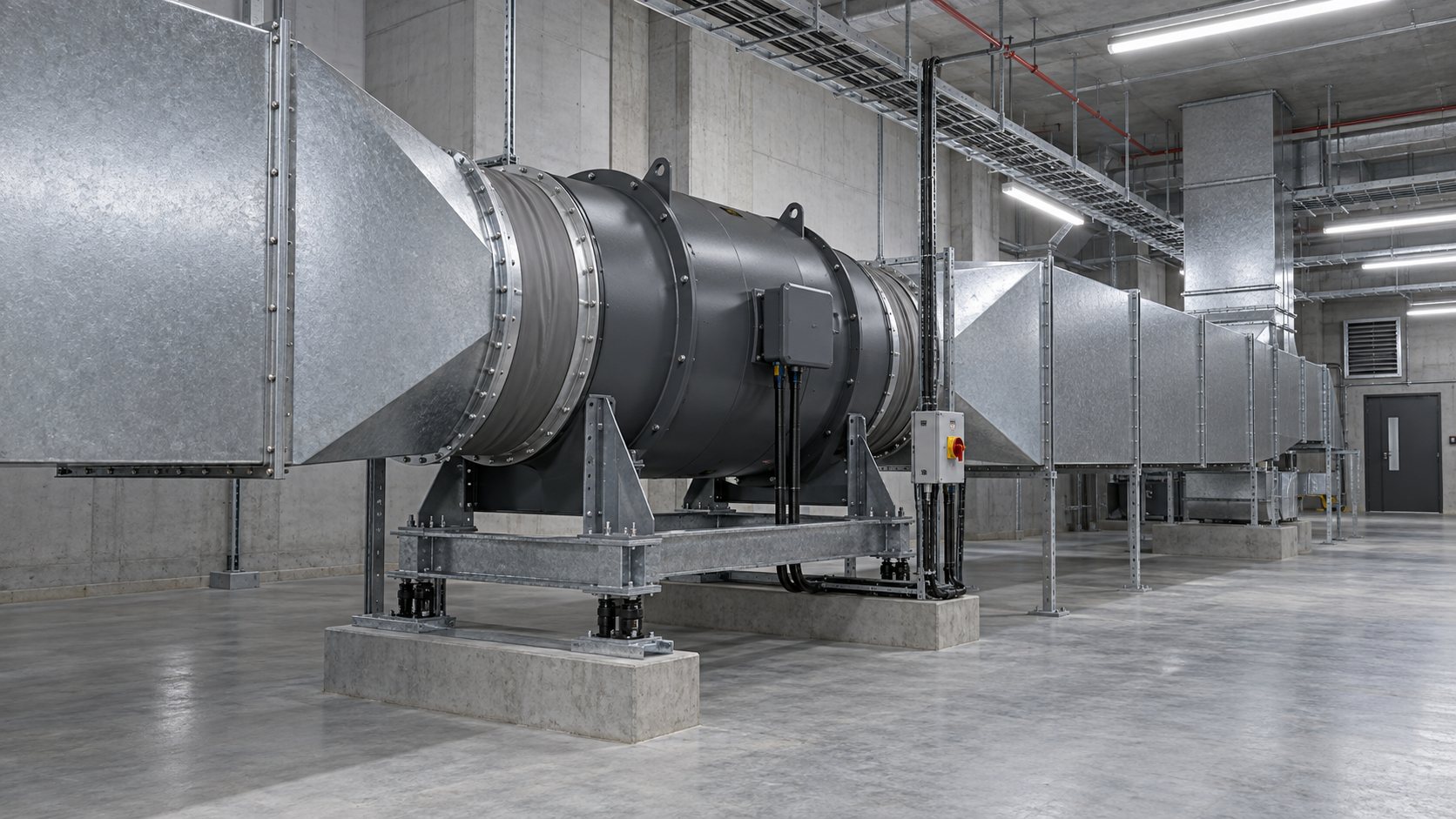
Powered smoke and heat control ventilators, including ducted smoke extract fans and impulse or jet fans, are covered by BS EN 12101-3. A fan should be selected as part of the complete smoke-control design, with evidence that its declared performance suits the project duty and fire strategy.
Evidence to check before selection
- Required volume flow and external static pressure at the duty point.
- Declared fire-temperature class and operating duration.
- Whether the fan is inside or outside the smoke reservoir.
- Fan orientation, location, ambient conditions and maintenance access.
- Primary and standby power, controls and cause-and-effect requirements.
- Compatibility of any variable-speed drive, starter, cabling and control arrangement.
Coordinate the fan with the ductwork
The fan duty must include the resistance of the complete route, including smoke-control ductwork, bends, transitions, attenuators, dampers, grilles and discharge arrangements. Duct classification, leakage, pressure limits and compartment crossings should be checked against the relevant evidence. See the guidance for BS EN 1366-8 multi-compartment systems and BS EN 1366-9 single-compartment systems.
Information needed for a useful enquiry
- Smoke-control strategy and design objective.
- Design airflow, pressure and operating scenario.
- Required temperature and duration classification.
- Duct sizes, route, resistance calculation and discharge location.
- Electrical supply, controls, standby arrangements and acoustic limits.
Important: This page is general guidance, not a smoke-control design or product selection. The project fire strategy, calculations, fan evidence and complete system arrangement must be reviewed by the responsible competent parties.