
Car-park ventilation has two distinct jobs: controlling vehicle pollutants during normal use and managing smoke during a fire. The fire-mode strategy must be established before fans, smoke-control ductwork, dampers, controls or power supplies are selected.
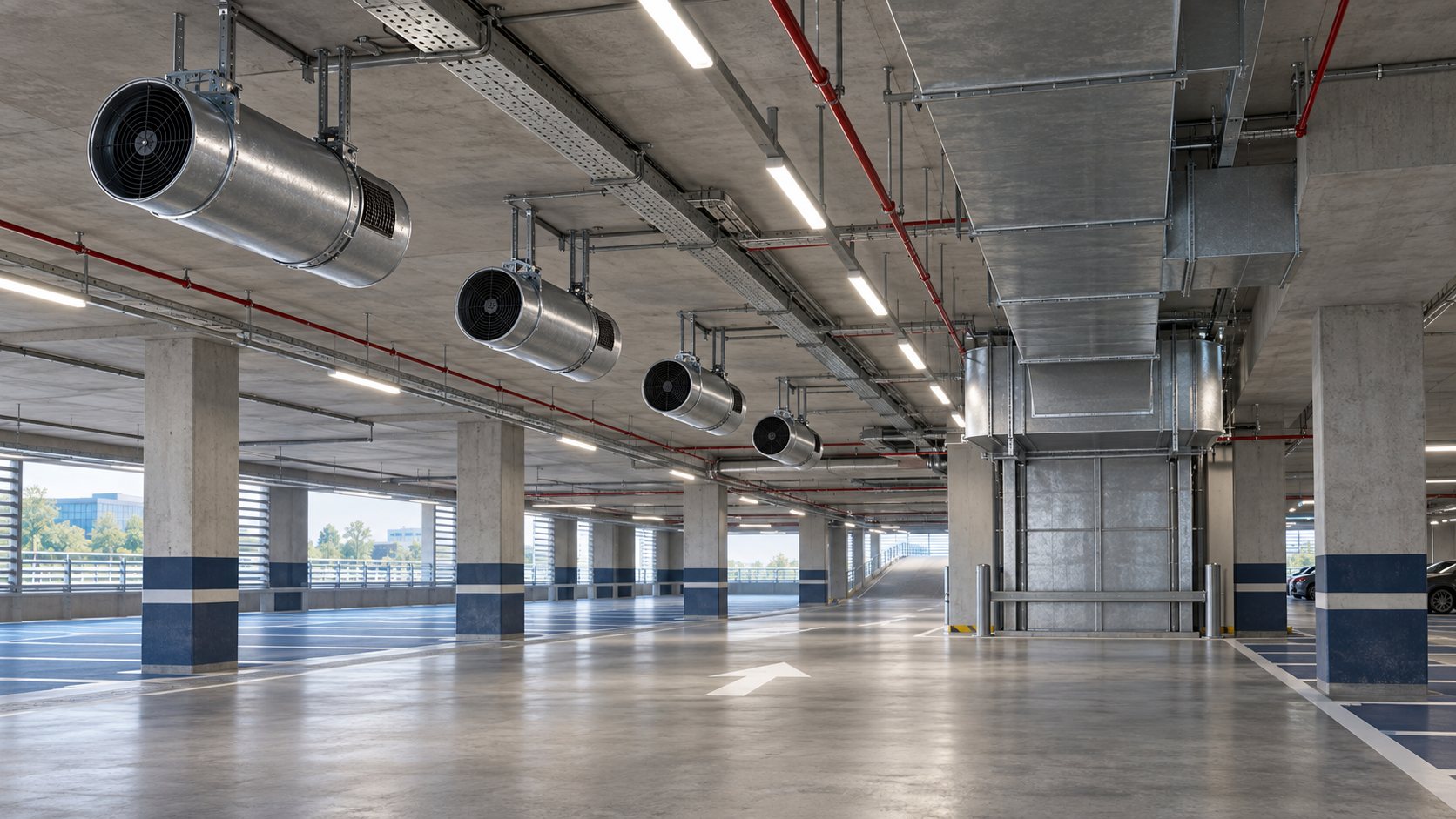
Start with the car-park and fire strategy
The appropriate route depends on whether the car park is open-sided, naturally ventilated, enclosed or below ground. It also depends on the approval strategy: a prescriptive extract arrangement and a designed smoke-control system are not interchangeable.
Mechanical fire ventilation in England
For an enclosed car park where the minimum natural ventilation cannot be achieved, Approved Document B Volume 2 describes a mechanical approach based on:
- A fire-mode extract rate of 10 air changes per hour.
- Two parts, each able to extract 50% of the required rate and operate independently.
- Independent power arrangements so a single failure does not remove the complete extract duty.
- Extract outlets divided between high and low level.
- E, I and S smoke-control ductwork tested in accordance with BS EN 1366-8.
- Smoke extract fan evidence considered against BS EN 12101-3.
Approved Document B also identifies BS 7346-7 as an alternative design route for smoke ventilation in enclosed car parks. Building Regulations guidance differs across the UK, so the applicable national guidance and project fire strategy must be confirmed.
Impulse and jet-fan systems
Impulse or jet fans can help move smoke towards extract points, but they do not remove the need for a complete engineered system. Fan thrust, extract duty, make-up air, smoke movement, escape and firefighting objectives, structural obstructions, controls and failure scenarios should be addressed by the responsible smoke-control designer. Where modelling is used, its assumptions must match the proposed installation.
Coordinate fans, ducts and controls
- Confirm normal ventilation and fire-mode duties separately.
- Record fan duty points, temperature classifications and operating duration.
- Check duct dimensions, pressure, leakage, route and compartment crossings.
- Coordinate smoke-control dampers, attenuators, grilles and discharge points.
- Define primary and standby power, controls and cause-and-effect operation.
- Provide safe access for inspection, cleaning, testing and maintenance.
- Commission the complete installed system against the approved design.
For duct routes that cross fire compartments, see the BS EN 1366-8 guidance. For fan-selection inputs, see Smoke Control Fans.
Important: This is introductory guidance only. Car-park smoke control is a life-safety design matter and should be developed, approved, installed and commissioned by the responsible competent parties using current project-specific requirements.